
AI Creates BIM Models from Paper Drawings — 98.8% Precision, Zero Manual Modelling
Imagine taking a stack of scanned engineering drawings — the old, paper kind from the 1980s — and having a complete 3D BIM model in hours. No Revit. No manual modelling. At 98.8% precision. This is not a future vision. It is a result published in February 2026 by researchers at Suzhou University of Science and Technology. And it changes how we think about building digitisation.
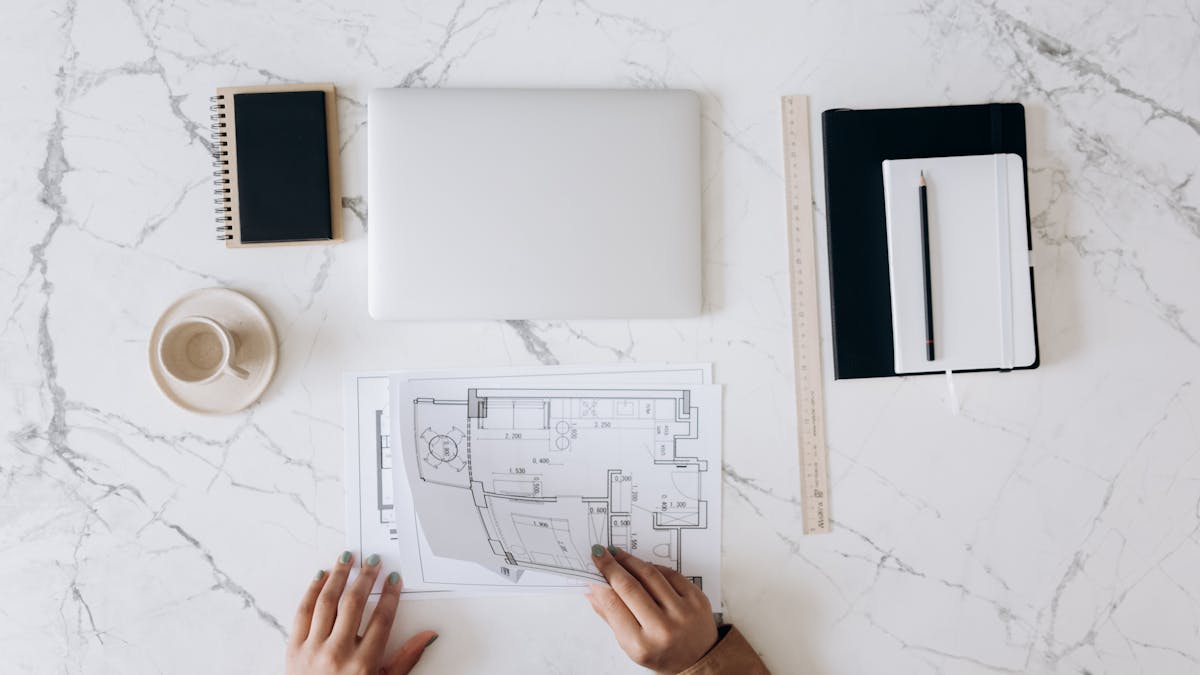
The breakthrough: from 2D pixels to 3D solids
For decades, converting old engineering drawings to BIM models required one thing: a person sitting at a screen, manually reconstructing geometry in Revit. Hour after hour. Wall by wall. The work is tedious, expensive, and prone to human error.
The Chinese team developed DBAL-YOLO — a deep learning framework that automatically detects structural elements in scanned 2D drawings (beams, columns, walls) and reconstructs a complete 3D building model from them.
How does it work? The system has three modules. First, element detection — an enhanced YOLO (You Only Look Once) algorithm recognises structural components in the dense linework of engineering drawings. Standard YOLOv11n struggles with narrow, elongated elements like beams and columns — so the team added Dynamic Snake Convolution to improve sensitivity to longitudinal shapes.
Second, geometric correction — OCR (Optical Character Recognition) reads dimensional text from the drawing and aligns detected elements to standard architectural modules. The system automatically corrects geometric errors caused by scanning noise.
Third, 3D reconstruction — a custom Python-based engine generates a complete solid model, combining structural data with wall information extracted by a U-Net segmentation model.
Key numbers: detection precision of 98.8%, recall of 98.3%, tested on a dataset of 3,960 annotated drawings. Published in the peer-reviewed journal Smart Construction (indexed in Scopus).
Crucially, the framework operates independently of commercial BIM software. It generates 3D solids directly from 2D pixel data.
The bigger picture — AI in scan-to-BIM in 2026
This paper is not an isolated case. In 2026, the entire scan-to-BIM workflow is being transformed by AI.
What AI can already do
Planar surface detection from point clouds — machine learning algorithms reliably recognise walls, ceilings, and floors in 3D laser scanner data. The best tools achieve 85–95% accuracy for standard commercial and residential buildings.
Automatic element classification — AI distinguishes beams from pipes, ventilation ducts from structural elements. Qonic QI (mentioned in our agentic BIM article) automatically classifies IFC elements, saving 50–80% of model preparation time.
Occlusion resolution — generative models intelligently fill gaps in scan data, predicting obscured elements based on architectural context and surrounding geometry.
Damage detection — AI identifies not just building elements but their condition, automatically flagging corrosion, deformation, and structural anomalies during the modelling process.
What AI still cannot do (honestly)
To be straightforward: in 2026, fully automated scan-to-BIM does not exist. The best tools (BIMIT Engine 3.0, PointCab Origins, Leica CloudWorx) accelerate workflows by 20–40% but do not eliminate the human.
Elements that still require human expertise include complex MEP systems (pipes, ducts, fittings — too many variants for current AI models), non-standard structures (arches, vaults, heritage elements), material properties and fire ratings (AI recognises geometry but doesn't "know" whether a wall is REI 120), and quality assurance at LOD 300+ (production documentation requires verification by an experienced modeller).
The realistic picture: AI handles 60–80% of the heavy work (detection, classification, initial modelling). The human handles 20–40% (verification, completion, QA/QC). Together — faster, cheaper, and more accurate than ever.
What this means for building digitisation
Every country has vast building stock without digital documentation. Residential blocks from the 1960s–80s. Industrial facilities. Heritage buildings. Public infrastructure. Millions of square metres whose only documentation is paper drawings in archives — if they exist at all.
The DBAL-YOLO framework opens the door to mass digitisation — not building by building manually in Revit, but automatically, with research-grade precision.
For firms offering 3D scanning and BIM conversion services — and archBIM.cloud is one of them — this is a game changer. Not because AI replaces us. Because AI allows us to do more, faster, and at lower cost — while maintaining the quality guaranteed by experience across more than one million square metres designed in BIM.
Our hybrid workflow
At archBIM.cloud, we have long combined AI technologies with manual expertise. Our scan-to-BIM process works as follows:
3D scanning — precise data from laser scanners, point cloud at ±2 mm accuracy.
AI-assisted processing — automatic element detection, initial classification, occlusion resolution.
Manual verification and completion — experienced modeller verifies the model, adds material properties, ensures compliance with LOD requirements.
Delivery — complete BIM model in Revit, ready for design, coordination, or facility management.
The result? Faster than fully manual, more accurate than fully automated.
Timeline: when will AI take over scan-to-BIM?
Based on current research and market development ($16 billion in the 3D scanning sector by 2030, growing at 4.5% annually):
Now (2026) — hybrid workflow. AI speeds things up by 20–40%. Humans essential for QA/QC and complex elements. This is the sweet spot.
2027–2028 — AI will handle most architectural detection (walls, windows, doors, stairs) at 95%+ accuracy. MEP remains challenging.
2029–2030 — MEP detection reaches production usability. Digital twins fed automatically by BIM models from regular rescans. "One-click scan-to-BIM" for standard buildings.
2030+ — full automation for typical structures. Humans needed only for heritage, non-standard construction, and QA on critical projects.
Don't wait for full automation — use the hybrid approach today
A building with no documentation? Paper drawings in an archive? An incomplete CAD model from the 1990s? We have a solution — now, not in 5 years.
We'll assess your project, propose a workflow (3D scanning, drawing conversion, or hybrid), and provide a quote. Our experience spans projects from 7,000 m² to 140,000 m² across 7 countries.
FAQ {#faq}
Can AI automatically create BIM models from 2D drawings?
Yes — DBAL-YOLO achieves 98.8% detection precision and generates complete 3D models from scanned engineering drawings. But production use still requires human verification.
Will AI replace manual scan-to-BIM modelling?
Not soon. In 2026 it's a hybrid workflow: AI does 60–80%, humans verify and complete. Together — faster and more accurate than ever.
What AI tools for scan-to-BIM are available?
PointCab Origins, Leica CloudWorx, Scan2BIM AI, Reconstruct, BIMIT Engine 3.0. All require human verification at LOD 300+.
What does this mean for scan-to-BIM providers?
20–40% speed improvement. Human value is increasing — expertise in complex structures and QA/QC becomes premium.
What is DBAL-YOLO?
A deep learning algorithm based on YOLOv11n with enhanced detection of elongated structural elements. 98.8% precision, 98.3% recall on 3,960 drawings.

![Forma Building Design — Autodesk's New Tool Changes Schematic Design [2026]](/images/blog/forma-building-design-hero.jpg)
![Digital Twin in Buildings: What the Autodesk Tandem–Globant Partnership Changes [2026]](/images/blog/digital-twin-budynek-hero.jpg)