
BIM Management — Coordination & 3D Modeling
Comprehensive BIM process management — from 3D modeling at LOD 100–500 through multi-discipline coordination and clash detection, to documentation, digital twin and investor support. ISO 19650 compliant.
What is BIM Management?
BIM Management is the comprehensive management of the Building Information Modeling process — from 3D modeling at LOD 100–500, through multi-discipline coordination and clash detection, to CDE configuration and ISO 19650 compliance oversight. Our approach combines technical knowledge with hands-on experience gained on prestigious projects, enabling us to deliver solutions tailored to the real needs of your team.
Our experience spans projects from 5,000 to 80,000 m² — from multi-family residential in Warsaw to logistics facilities in Italy and schools of architecture in France.
We support design offices, developers and contractors in the transition to a digital workflow -- from initial conceptual sketches to the digital twin of the finished building. We work in accordance with ISO 19650, prepare BEP, EIR, LOD/LOI matrices and configure Common Data Environments (CDE).
design
19650
implementation
BIM service scope
BIM Modeling
Creating 3D models at LOD 100-500 for every investment phase -- from concept to as-built. Architectural, structural and MEP models in Autodesk Revit.
LOD 100-500BIM Coordination
Multi-discipline coordination and clash detection -- identifying clashes between architectural, structural and MEP models before they reach the construction site.
Clash DetectionBIM Documentation
Automatic generation of 2D drawings, material schedules and technical specifications directly from the model -- always up to date and consistent with the 3D model.
AutomationLaser Scan → BIM
Converting point clouds from 3D laser scanning into a precise BIM model of an existing building. An ideal solution for revitalization and inventory projects.
Point CloudCAD → BIM
Migration of existing 2D CAD documentation to full BIM information models while preserving all design details and data layers.
MigrationFamily Modeling
Creating dedicated Revit components and parametric family libraries tailored to project requirements and office standards.
Revit FamiliesBIM for investors
Advisory on BIM requirements in tenders, verification and audit of models delivered by contractors, oversight of EIR compliance.
AdvisoryBIM Management
Common Data Environment (CDE) setup, BEP and EIR preparation, LOD/LOI matrices, procedures and standards compliant with ISO 19650.
ISO 19650How do we deliver BIM projects?
From analysis and inventory, through discipline modeling, to coordination and delivery of complete documentation.
Analysis and inventory
Assessment of current processes, analysis of input documentation and building inventory. Defining project objectives, LOD/LOI requirements and BIM standards.
Environment setup
Configuration of CDE, Revit templates, family libraries and naming standards. Preparation of a BEP compliant with ISO 19650 and team training.
Discipline modeling
Creating architectural, structural and MEP models at the required LOD. Working in a worksharing environment with ongoing quality control.
Coordination and clash detection
Multi-discipline coordination, clash detection and report generation. Iterative issue resolution with design teams until a clash-free model is achieved.
Documentation and delivery
Generating complete 2D documentation from the model, IFC export, material schedules and specifications. Handover of the model together with BEP documentation and final report.
Benefits of BIM
Early error detection
Clash detection eliminates up to 40% of multi-discipline clashes before they reach the construction site, saving time, costs and the nerves of the construction team.
Efficiency +30%
Working in BIM shortens design time by up to 30% compared to traditional CAD, and automated documentation eliminates manual schedules.
IFC and VR compatibility
IFC export ensures interoperability with any BIM software. VR visualizations enable immersive project presentations before construction begins.
Digital Twin
A digital twin of the building enables facility management throughout its entire lifecycle -- from design, through construction, to operation and facility management.
AI in architecture
and BIM
We leverage artificial intelligence to automate BIM processes -- from automatic modeling from point clouds, through generating design variants, to energy optimization of buildings. AI can deliver up to +30% increase in design capabilities and -20% reduction in construction costs.
- Automatic BIM modeling from point clouds
- Generative design variants
- Energy and material optimization
- Predictive clash detection
Featured projects
Selected BIM projects delivered for clients across various sectors.
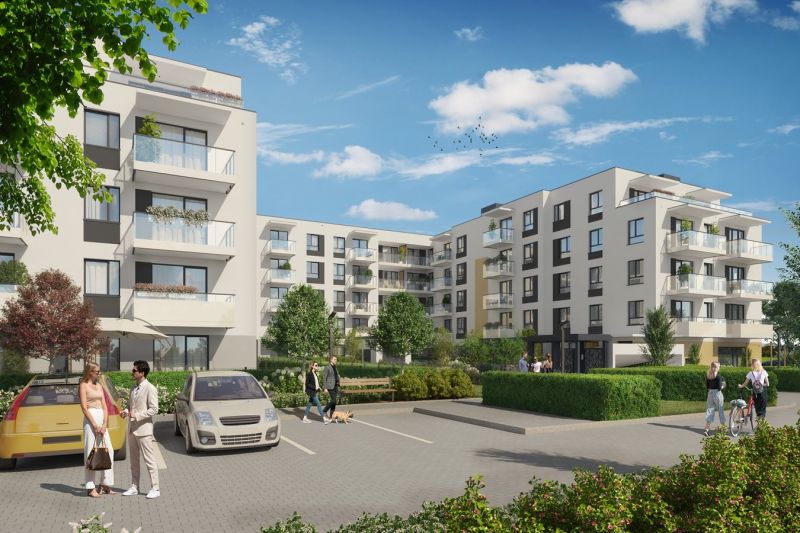
Residential Complex, Warsaw
Eight multi-family buildings for DOM Development. Full BIM coordination across all disciplines on CDE in compliance with ISO 19650. Detailed design at LOD 350.
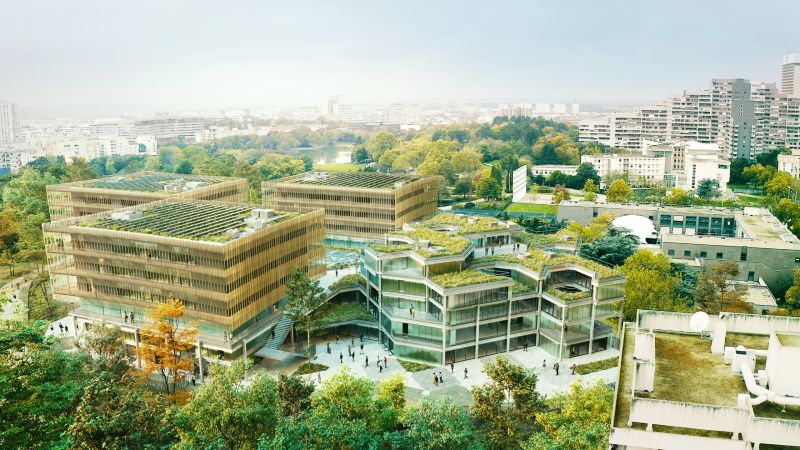
School of Architecture, Nanterre
Conversion of an existing building into a new school of architecture near Paris. Full BIM project from concept through detailed design with multi-discipline coordination. LOD 350.
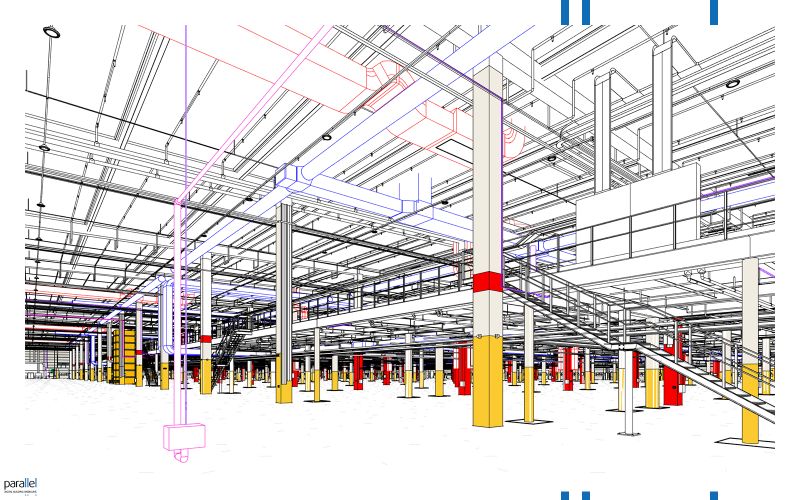
Amazon Sorting Centre, Italy
BIM Management and construction coordination for a logistics facility. All subcontractors working in BIM, data exchange via CDE, weekly coordination meetings. LOD 400.
Frequently Asked Questions
What is BIM Management and how does it differ from traditional CAD?
BIM Management is the comprehensive management of the Building Information Modeling process — from creating 3D models through multi-discipline coordination to quality control and ISO 19650 compliance. Unlike CAD, a BIM model contains complete information about every building element: materials, costs, schedules and inter-discipline dependencies. This allows us to detect clashes at the design stage, and documentation is generated automatically from the model.
How long does BIM implementation take in a design office?
A typical BIM implementation takes 2 to 4 months and includes a process audit, environment setup (CDE, Revit templates, family libraries), team training and a pilot project launch. The timeline depends on team size and current skill level — some offices need intensive initial support, while others require only configuration and mentoring.
What are the benefits of BIM coordination and clash detection?
BIM coordination and clash detection can identify up to 40% of multi-discipline clashes before they reach the construction site. This means fewer corrections, lower construction costs and shorter build times. Through regular coordination sessions and reports from Navisworks/Solibri, design teams resolve issues iteratively before they become costly changes on site.
Free BIM audit
Book a free consultation. We will analyze your processes and show you how BIM can increase your team's efficiency by up to 30%.